
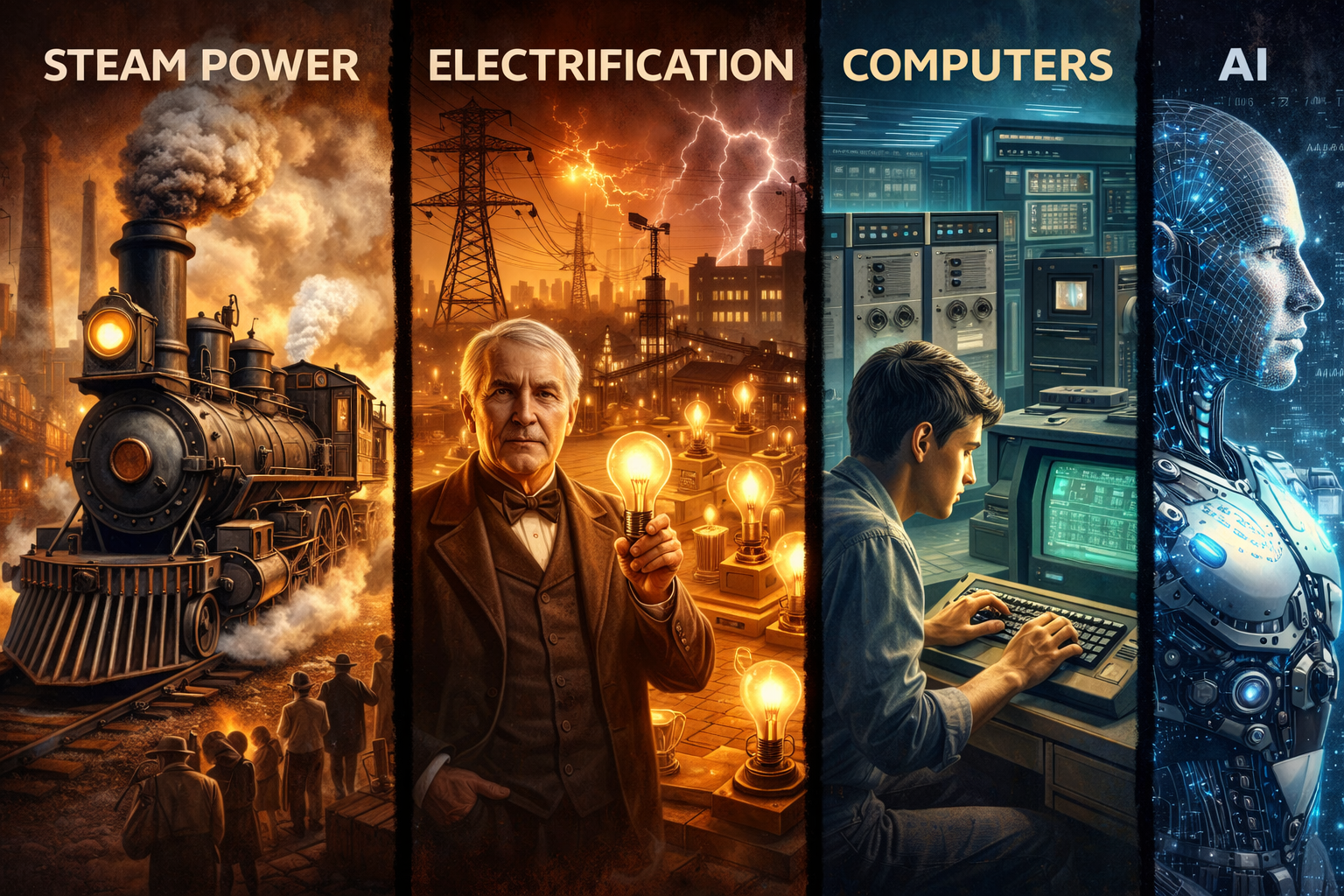
Over the last 250 years, every major technological breakthrough has been greeted with the same ominous prediction: mass job loss, social upheaval, and economic collapse. The arrival of steam power was supposed to end work as we knew it. Electrification was feared as a destroyer of skilled trades. Computers were accused of replacing entire professions. The internet was blamed for hollowing out economies. And now, artificial intelligence sits squarely in the crosshairs.
History tells a different story.
Yes, technological revolutions create short-term disruption. Certain roles diminish, others disappear, and entire industries are forced to adapt. That discomfort is real and should not be dismissed. But what follows—every single time—is something far more powerful: an explosion of new opportunities, new forms of employment, and unprecedented wealth creation.
Steam power didn’t eliminate work; it scaled it. Electrification didn’t destroy productivity; it multiplied it. Computers didn’t replace human thinking; they amplified it. The internet didn’t end commerce; it globalized it.
AI is no different.
What makes artificial intelligence transformative is not that it replaces humans, but that it empowers them with capabilities that were unimaginable just a few years ago. Tasks that once required teams, time, and capital can now be accomplished faster, cheaper, and with greater reach. This lowers the barrier to entry for innovation and entrepreneurship in ways we are only beginning to understand.
Crucially, AI also shines a spotlight on what it cannot do well.
AI struggles with empathy. It cannot genuinely build trust. It does not navigate human nuance, persuasion, or emotional complexity with authenticity. Teaching, mentoring, influencing, supporting, and leading through uncertainty remain deeply human skills. Human nature is inconsistent, emotional, and context-driven—and humans are uniquely equipped to deal with that, at least for the foreseeable future.
As AI takes over repetitive, analytical, and operational tasks, it creates space for people to focus on higher-value activities rooted in connection, creativity, judgment, and meaning. Entire new professions, business models, and industries will emerge around these strengths, just as they have after every previous technological shift.
The real risk is not AI itself. The risk is assuming the future will look like the past—and failing to step into the opportunities that change inevitably creates.
History has been clear. Technology doesn’t end work. It changes who wins.


